
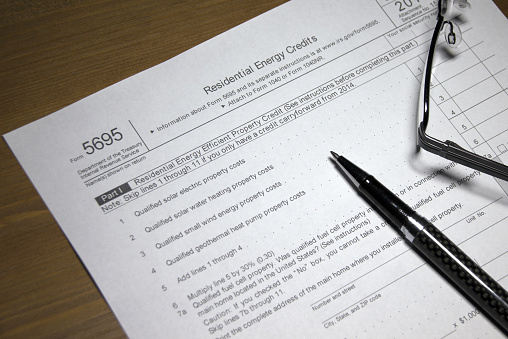
The Residential Energy Credit, reported using Form 5695, is a U.S. federal tax credit designed to encourage individuals to invest in energy-efficient improvements and renewable energy systems for their homes. The credit is part of the government’s initiative to reduce energy consumption and promote environmentally friendly energy sources.
Key Features of Form 5695:
- Purpose:
- To calculate and claim credits for making qualified energy-efficient improvements to your home.
- To claim renewable energy tax credits for installing systems like solar panels or wind turbines.
- Credits Available:
- Residential Clean Energy Property Credit (Section I):
- Covers renewable energy installations such as:
- Solar panels (photovoltaic systems).
- Solar water heaters.
- Wind turbines.
- Geothermal heat pumps.
- Fuel cells.
- As of recent laws (e.g., the Inflation Reduction Act of 2022), the credit is set at 30% of the cost for qualifying systems installed from 2022 to 2032.
- Covers renewable energy installations such as:
- Energy Efficient Home Improvement Credit (Section II):
- For improvements like:
- Energy-efficient windows, doors, and skylights.
- Insulation materials or systems.
- HVAC systems, water heaters, or heat pumps.
- Home energy audits.
- The annual credit limit is up to $1,200 for certain upgrades (e.g., $600 for windows, $500 for doors).
- For improvements like:
- Residential Clean Energy Property Credit (Section I):
- Eligibility:
- The property must be the taxpayer’s primary residence (for most credits).
- Both existing homes and new constructions may qualify, depending on the credit.
- Filing Form 5695:
- Attach it to your federal income tax return (Form 1040).
- Report the costs of the improvements or installations.
- Calculate the credit amount you’re eligible to claim.
- Any unused credit may sometimes be carried forward to the following tax year.
- Exclusions:
- Improvements made to rental properties are generally not eligible.
- Equipment must meet energy efficiency standards established by the Department of Energy or IRS guidelines.
By using Form 5695, taxpayers can reduce their tax liability while supporting sustainable energy practices.
Example :
Let’s say client spent $2000 for HVAC system,
If the $2,000 is for a standard HVAC system:
The maximum credit is $600, provided the system meets energy efficiency criteria.
If the $2,000 is for a heat pump:
The credit can be 30% of $2,000, which is $600, but the cap for heat pumps is $2,000, so your client could claim the full $600.
Example:
If your client spends $20,000 on a solar panel system:
- Credit = 30% × $20,000 = $6,000.
- If their tax liability for the year is only $4,000, they can use $4,000 of the credit this year and carry forward the remaining $2,000 to the next year.
Add a Comment